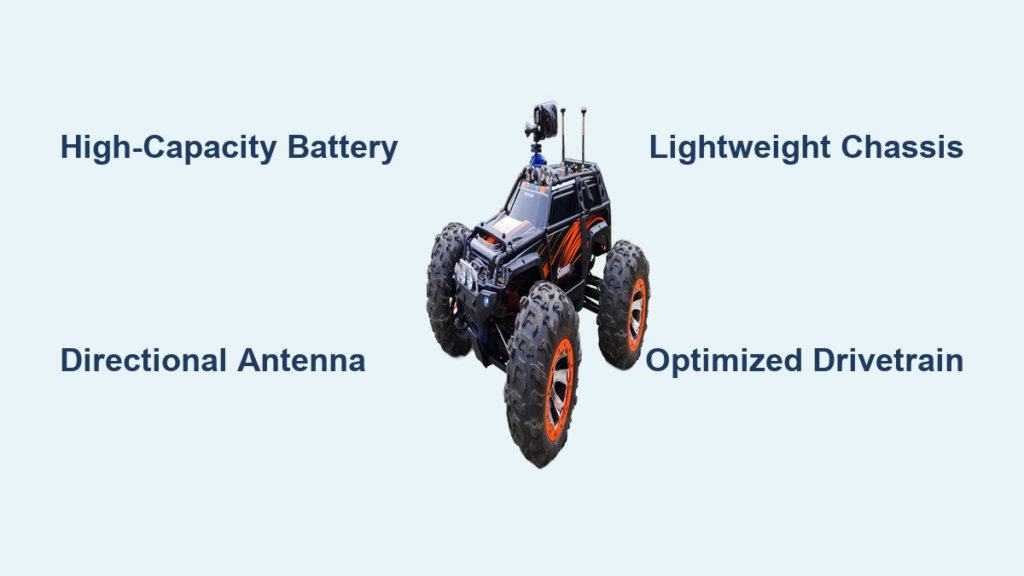
Your standard RC car might handle backyard races, but what happens when you want to explore beyond the usual boundaries? Achieving reliable control beyond 500 meters requires careful engineering across multiple systems. This guide reveals exactly how to make long range RC car builds that maintain solid signal at distances where most controllers fail. You’ll discover the specific component combinations, antenna configurations, and weight-saving techniques that serious long-range enthusiasts use to drive reliably at distances exceeding 1 kilometer.
Most beginners assume range depends solely on transmitter power, but experienced builders know the truth: a truly long-range RC system balances radio performance, electrical efficiency, and strategic weight reduction. Get any one element wrong, and your vehicle becomes uncontrollable at distances where proper builds thrive. Follow these proven methods to transform your RC car into a distance champion that outperforms stock models by 300-500%.
Choose the Right Motor and Battery Combination
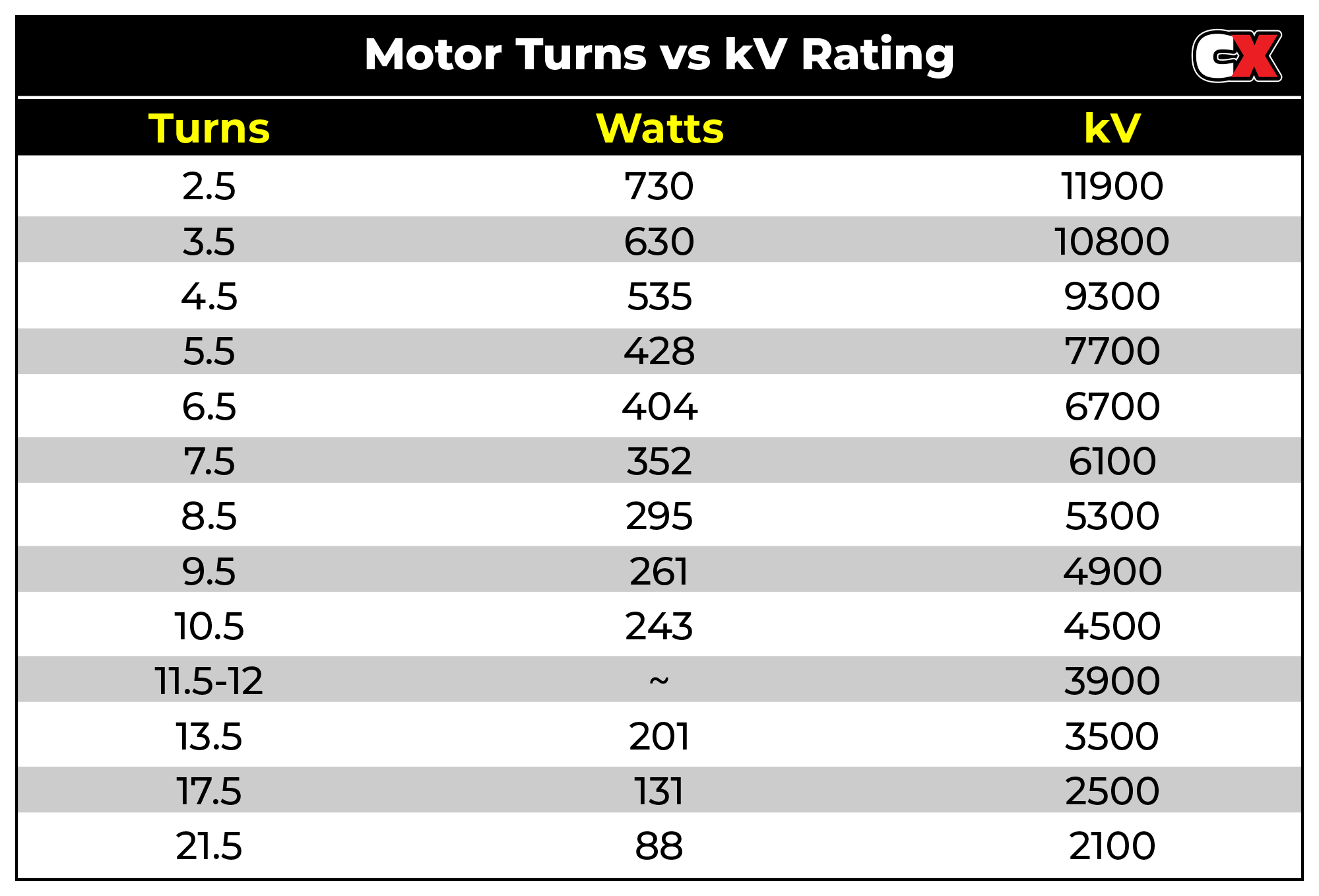
Your power system directly determines how far your RC car can travel before battery depletion. Selecting the correct motor-battery pairing creates the foundation for extended range operation.
Match Motor KV to Battery Configuration
Select brushless motors with KV ratings between 1500-2500 when using 2S LiPo batteries (7.4V), or 1000-1800 KV for 3S setups (11.1V). Higher KV motors spin faster but drain batteries quicker under load, while lower KV options deliver stronger torque for obstacle navigation with better efficiency. Critical mistake to avoid: Never pair a motor rated for 3S batteries with a 4S pack—this causes overheating and premature failure. Check the motor’s voltage rating label before installation.
For optimal long-range performance, sensored brushless motors provide smoother low-speed control essential when navigating distant terrain. The sensor feedback allows precise throttle modulation at walking speeds, preventing sudden surges that waste battery power. Install your motor with proper heat sinking—aluminum motor mounts dissipate heat 3x better than plastic alternatives, maintaining efficiency during extended drives.
Maximize Battery Capacity Without Excess Weight
Use high-capacity 3S LiPo batteries ranging from 5000-8000mAh for buggies and truggies. This capacity range provides the best energy-to-weight ratio for long-range applications. A 6000mAh pack delivers approximately 30% more runtime than a standard 4500mAh battery while adding only 15% more weight.
Pro tip: Position your battery pack centrally and as low as possible in the chassis. This lowers the center of gravity, improving handling at speed while maintaining optimal weight distribution. Secure the battery with Velcro straps rather than rigid mounts—this absorbs vibration that could damage battery cells during rough terrain operation. Always carry a battery voltage checker; running below 3.3V per cell permanently damages LiPo batteries and reduces future range.
Optimize Your Radio System for Maximum Signal

The radio system makes or breaks long-range performance. A properly configured transmitter-receiver setup maintains control when standard systems fail at 200-300 meters.
Upgrade to High-Power Transmitter with External Antenna
Replace your stock transmitter antenna with a 2.4GHz dipole antenna to gain 30-50% more range immediately. For serious long-range builds, install a 2.4GHz Yagi directional antenna on your transmitter—this focuses signal energy forward, effectively multiplying range in your driving direction. Warning: Directional antennas require precise aiming, so practice tracking your vehicle as it moves.
Inside the RC car, mount the receiver as high as possible with the antenna extending vertically at least 15cm above the chassis. Carbon fiber bodies allow better signal penetration than metal components, so avoid routing antenna near aluminum shock towers or motor mounts. For extreme range applications (800m+), consider a 900MHz radio system—these lower frequencies penetrate obstacles more effectively than 2.4GHz, though they require separate licensing in some regions.
Configure Receiver for Maximum Signal Sensitivity
Enable RSSI (Received Signal Strength Indicator) monitoring on your transmitter to track signal quality in real-time. Set your transmitter to display RSSI as a percentage rather than bars for more precise measurement. During range testing, note the RSSI value when control becomes inconsistent—this becomes your safety threshold for future drives.
Program your receiver for “fail-safe” mode that returns the vehicle to neutral throttle and centered steering if signal is lost. This prevents runaway accidents when pushing range limits. Test fail-safe activation at close range before attempting long-distance drives. Some advanced receivers allow custom fail-safe positions—set a slight brake engagement to prevent coasting after signal loss.
Build a Lightweight Chassis That Maximizes Efficiency

Every gram removed from your RC car translates directly to increased range. Strategic weight reduction affects battery consumption, acceleration, and handling.
Strategic Material Selection for Weight Savings
Replace aluminum chassis plates with carbon fiber equivalents—this typically saves 40-60% in weight while maintaining structural integrity. A complete carbon fiber upgrade (chassis, shock towers, suspension arms) can reduce total vehicle weight by 150-250 grams depending on model size.
Common mistake: Removing too much material from high-stress areas. Bulkheads and motor mounts require reinforcement, not reduction. Focus weight savings on non-critical components like body mounts, antenna brackets, and battery trays. Use titanium hardware for critical fasteners—titanium screws save 25% weight compared to steel equivalents while providing equal strength.
Optimize Drivetrain for Minimal Power Loss
Install ABEC-7 ball bearings throughout the drivetrain to reduce rotational friction by up to 30% compared to standard bushings. Properly lubricate bearings with lightweight silicone grease—never use heavy petroleum-based lubricants that create drag. Check all bearings monthly for smooth rotation; a single binding bearing can waste enough power to reduce range by 10-15%.
Adjust gear mesh to allow slight play when stationary but full engagement when rotating. Use gear marking compound to verify tooth contact across the entire gear face. Over-tightened gears create unnecessary drag that drains batteries faster, while loose gears waste power through slippage and noise.
Test and Refine Your Long Range Setup
Systematic testing reveals limitations in your current configuration and guides future improvements.
Conduct Controlled Range Testing
Begin range testing in an open field free from signal obstacles. Drive away while maintaining consistent speed, noting the distance where control becomes inconsistent. Repeat tests from multiple directions—range often varies significantly based on antenna orientation. Mark maximum reliable range with visible flags for future reference.
Record RSSI values at 50-meter intervals during testing. Create a range profile showing signal strength versus distance under different conditions (full battery, half battery, various weather). This data helps predict maximum safe range during actual use. Critical safety step: Always test with a spotter who can retrieve your vehicle if signal is lost.
Implement Progressive Range Improvements
Address the weakest link first in your range chain. If your vehicle loses signal at 400 meters while transmitter shows full strength, focus on receiver antenna optimization. If transmitter battery drains rapidly during range testing, upgrade to a higher-capacity transmitter pack.
Start with simple, low-cost improvements before major modifications. Replacing stock antennas often provides the best range-per-dollar return. Next, optimize weight distribution and drivetrain efficiency. Only after these fundamentals are perfected should you consider expensive upgrades like 900MHz radio systems.
Maintain Your Long Range RC System
Regular maintenance preserves the performance gains you’ve worked hard to achieve.
Battery and Connection Care
Inspect all electrical connections before each use, especially antenna connectors which suffer from vibration damage. Secure loose connections with silicone sealant to prevent intermittent failures at range. Clean battery contacts with isopropyl alcohol monthly to maintain optimal conductivity.
Store LiPo batteries at 3.8V per cell for long-term storage—neither fully charged nor discharged. Check batteries for swelling before every use; a slightly puffed battery has lost capacity and should be retired. Never leave charging batteries unattended, especially high-capacity packs used in long-range builds.
Antenna System Maintenance
Replace receiver antennas annually as a preventive measure—internal damage often occurs without visible signs. Check transmitter antennas for kinks or bends that affect radiation pattern. For directional antennas, verify mounting hardware remains tight to maintain precise aiming capability.
Before major range attempts, perform a complete signal check at close range. Walk around your vehicle while monitoring RSSI to identify dead spots caused by chassis interference. Adjust antenna position if necessary to eliminate signal nulls.
Building a reliable long-range RC car requires attention to multiple interconnected systems. By optimizing your power setup, radio configuration, and chassis weight, you’ll achieve consistent control at distances that amaze fellow hobbyists. Start with these fundamental improvements, test methodically, and document your results. Within weeks, you’ll be driving confidently at 500+ meters—distances where most RC cars become uncontrollable. The key isn’t one magic component, but the synergistic combination of proper motor selection, strategic weight reduction, and radio optimization that transforms ordinary RC cars into true long-range machines.