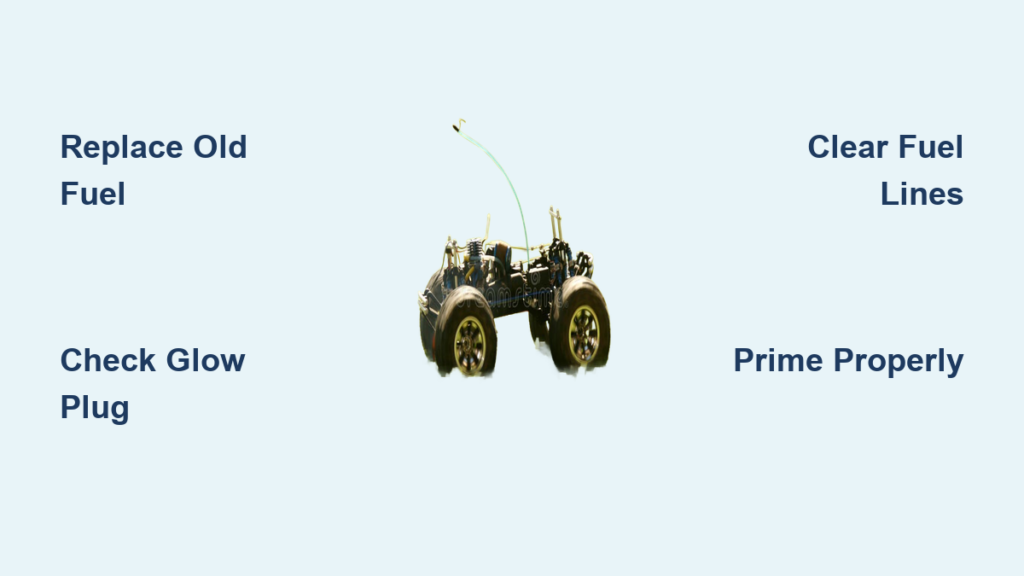
You’re ready to hit the track with your nitro RC car, but it won’t start. That frustrating moment when you pull the starter cord repeatedly only to hear silence instead of that satisfying engine roar is all too familiar for nitro hobbyists. Whether you’re a beginner with your first nitro vehicle or a seasoned racer, starting problems can happen to anyone. Most nitro RC car starting issues stem from just a few common causes that you can diagnose and fix with basic tools. This guide delivers the exact steps to identify why your nitro RC car won’t start and get your engine roaring back to life.
Before you disassemble your engine or order expensive replacement parts, follow this systematic troubleshooting approach. The majority of starting failures come from fuel system problems or glow plug issues—problems you can often fix in minutes. By methodically working through these common failure points, you’ll save time, money, and unnecessary repairs. Let’s get your nitro RC car running again.
Fix Your Nitro RC Fuel Delivery Issues Immediately

Your fuel system is the most common culprit when your nitro RC car won’t start. Ignoring simple fuel problems before diving into complex engine diagnostics wastes valuable track time.
Replace Old or Contaminated Nitro Fuel
Nitro fuel has a surprisingly short shelf life. Even when stored properly in sealed containers, most nitro fuels degrade after three to six months, losing their ability to ignite properly. If your fuel has been sitting in your workshop for more than a few months or was stored in a partially empty container, it’s likely the cause of your starting problems. Drain all old fuel from your tank and lines completely, then refill with fresh nitro fuel from a newly opened container. Verify you’re using the correct nitro percentage for your engine—most standard nitro RC cars require 20-30% nitro content. Never mix old and new fuel, as this compromises the entire batch.
Clear Clogged Fuel Lines and Tank Blockages
Inspect your fuel lines carefully for kinks, cracks, or internal residue buildup. Silicone fuel lines become brittle over time, developing tiny cracks that create air leaks or restricting fuel flow with accumulated deposits. Remove each fuel line segment and examine them against a light source—you should see clear passage through the entire length. Replace any lines showing cloudiness, cracks, or residue. While you have the lines disconnected, check your fuel tank for cracks and ensure the pick-up tube isn’t clogged. A quick blast of compressed air through the tank outlet should clear any debris blocking the pick-up.
Reset Your Carburetor Needle Valve Settings
Your carburetor’s needle valve controls the critical air-fuel mixture, and incorrect settings prevent starting regardless of other systems functioning properly. If your nitro RC car won’t start, reset the needle valve to the manufacturer’s recommended starting position—typically one and a half to two turns out from fully closed. Turn the screw clockwise to lean the mixture (less fuel) or counterclockwise to richen it (more fuel). After resetting, prime the engine properly and attempt to start again. If it fires but dies immediately, you’re likely too lean; if it floods with fuel, you’re too rich. Make adjustments in quarter-turn increments only.
Replace Faulty Glow Plugs Before Anything Else
The glow plug creates the ignition source in your nitro RC engine, and a failed glow plug causes more starting issues than almost any other single component. Testing and replacing your glow plug should be your second diagnostic step after checking fuel.
Identify Dead or Fouled Glow Plug Symptoms
A failing glow plug creates unmistakable symptoms: your engine cranks normally but shows no signs of firing, or it starts briefly then immediately dies. Carbon buildup on the plug tip insulates the heating element, while complete burnout means the filament has failed. Both conditions prevent ignition regardless of other systems functioning correctly. If your glow plug appears blackened with carbon deposits or shows a broken filament when inspected closely, replace it immediately. Always carry spare glow plugs to the track—you’ll need them more often than you think.
Test Your Glow Plug in 10 Seconds
Testing a glow plug requires only a standard 1.5V battery and ten seconds of your time. Remove the glow plug and touch its terminals to a AA battery or your glow plug igniter’s battery terminals. A healthy glow plug heats to a bright cherry-red color across the entire tip within seconds. If it glows dull orange, only partially, or not at all, it has failed and needs replacement. Test your glow plug igniter simultaneously by connecting it to a known working plug—a weak igniter battery can make a good plug appear bad. Always match your new glow plug’s heat range to your engine’s requirements: cold plugs for high-nitro engines and hotter plugs for lower-nitro applications.
Diagnose Mechanical Engine Failures Properly

If your fuel system checks out and your glow plug functions correctly, mechanical engine problems may be preventing your nitro RC car from starting. These issues require careful diagnosis before attempting repairs.
Check for Engine Seizure and Compression Loss
Engine seizure occurs when internal components overheat and lock together, preventing rotation. Before forcing the starter, check if your engine turns over freely by rotating the flywheel manually. If it resists movement or won’t turn at all, seizure has likely occurred. Never use the starter on a seized engine—this causes catastrophic damage. Soak the engine in after-run oil for 24-48 hours, then gently work the flywheel back and forth. Compression loss from worn piston-sleeve assemblies also prevents starting. Test compression by blocking the exhaust outlet and rotating the flywheel—it should feel tight with strong resistance throughout the rotation.
Clear Crankcase Ventilation Blockages
Your engine’s small breather hole allows pressure to escape as the piston moves, and when clogged with dirt or fuel residue, it creates pressure imbalances that disrupt starting. Locate the breather hole—typically found on the side of the crankcase near the engine’s rear—and clean it using a small pick or compressed air. Ensure the vent tube connects properly without kinks or blockages. This simple maintenance step resolves many mysterious starting problems that seem unrelated to other systems.
Master Proper Starting Technique Every Time
Even with perfect components, incorrect starting technique prevents your nitro RC car from starting. Many hobbyists skip critical steps or perform them incorrectly, creating problems that seem mechanical.
Prime Your Engine Without Flooding
Proper priming introduces fuel into the combustion chamber without flooding the engine. Close the choke, seal the air filter opening, and pull the starter two to three times. You should see fuel traveling through clear fuel lines toward the carburetor. Once fuel movement is visible, open the choke one to two turns, install the glow plug igniter, and pull the starter five to ten firm, consistent pulls. Watch for signs of ignition—remove the choke immediately once the engine catches and runs smoothly. Always prime sparingly; two to three pulls should be sufficient.
Use the Choke Correctly for Cold Starts
The choke creates a richer fuel mixture that ignites easier in a cold engine. When starting cold, close the choke completely. As the engine warms and runs consistently, gradually open the choke to allow more air into the mixture. Leaving the choke closed too long washes lubrication from cylinder walls, while opening it too quickly causes stalling. Adjust based on engine response—once it idles smoothly with the choke fully open, your engine has reached operating temperature.
Maintain Your Nitro RC Car to Prevent Starting Issues
Preventive maintenance drastically reduces starting problems. After each run, run your fuel tank dry and spray after-run oil into the exhaust and carburetor while rotating the engine manually. Store your nitro RC car in a temperature-controlled environment away from direct sunlight. Replace glow plugs every five to ten runs, clean fuel lines monthly, and rebuild your carburetor every 20-30 runs. Keep spare glow plugs, fuel lines, and igniter batteries at the track so a single failed component doesn’t end your racing day.
By following this systematic approach, you’ll diagnose why your nitro RC car won’t start 90% of the time. Most issues trace back to fuel quality, glow plug condition, or starting technique—problems you can fix with basic tools. When more serious mechanical issues arise, understanding your engine’s systems helps you communicate effectively with experienced hobbyists for proper repairs. Keep this guide handy at your workbench and trackside, and you’ll spend less time troubleshooting and more time racing.