There’s nothing more frustrating than watching your RC car flip during an exciting run, especially when it leads to damaged components and lost momentum in your driving session. RC car flipping happens to hobbyists of all skill levels, whether you’re navigating rough terrain with a crawler or pushing the limits on a race track. The good news is that most flipping incidents aren’t random—they result from specific, addressable factors related to your vehicle’s setup, your driving technique, and the environment. By understanding what causes your RC car to flip and implementing targeted solutions, you can keep your vehicle grounded and enjoy more consistent performance. This guide provides practical, actionable steps to diagnose flipping issues and implement effective fixes that work for your specific RC model and driving conditions.
Diagnose Your Flipping Pattern First
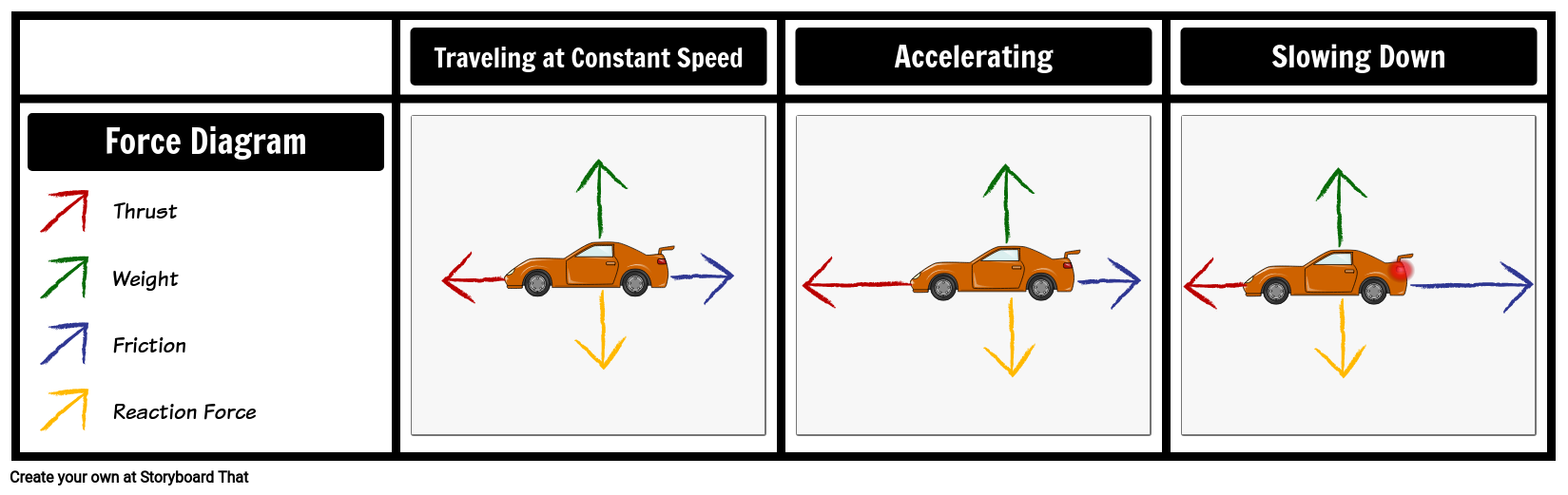
Before making any modifications, you need to pinpoint exactly when and how your RC car flips. Different flipping scenarios require different solutions, so accurate diagnosis prevents wasted time and money on ineffective adjustments. Take notes during your driving sessions to identify patterns in your flipping incidents.
Cornering flips happen when centrifugal force overcomes your vehicle’s stability during turns. If your car consistently flips when taking corners at speed, you’re likely dealing with suspension settings that are too soft, inappropriate tires for your surface, or simply entering corners too aggressively. These flips typically occur when the outside tires lose traction while the inside tires lift off the ground completely. Pay attention to whether flips happen in left turns, right turns, or both—this asymmetry can indicate alignment issues or uneven weight distribution.
Straight-line flips often indicate a high center of gravity combined with sudden steering inputs or terrain obstacles. When your car flips while driving straight, check if it happens when hitting bumps, during acceleration on inclines, or when making slight directional adjustments. Crawlers and trail trucks are particularly prone to this issue due to their taller bodies and longer suspension travel. If your car flips backward during acceleration, you may have too much weight in the rear or insufficient front downforce.
Jump and landing flips represent a distinct category where your car becomes airborne and lands unbalanced. These incidents usually stem from improper throttle control mid-air, incorrect landing angles, or suspension settings that don’t absorb impact properly. A car that consistently flips upon landing needs different shock tuning rather than fundamental stability modifications. Notice whether your car flips forward (nose over) or backward (tail over) as this indicates different weight distribution problems.
Optimize Your Center of Gravity Immediately

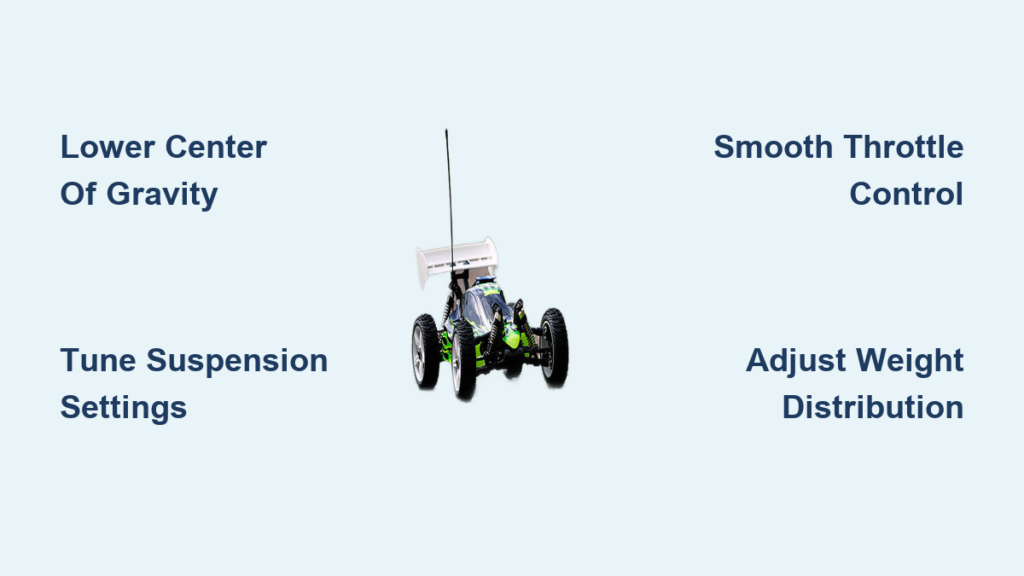
Your RC car’s center of gravity directly determines its resistance to flipping. Vehicles with weight concentrated low in the chassis resist rolling much better than those with mass sitting high above the wheels. Addressing this factor often provides the most significant stability improvement with minimal cost.
Reposition your battery pack to lower the center of gravity significantly. In most electric RC cars, the battery represents the heaviest single component. Move saddle pack batteries to the lowest possible position in the chassis or switch to shorty packs that sit flush with the suspension mounts. For vehicles with multiple battery options, select the configuration that places the most weight closest to the ground. Even lowering your battery by 5-10mm can dramatically improve cornering stability.
Consider adding wheel weights to improve stability without raising your center of gravity. Small lead weights attached to your wheels lower unsprung weight distribution toward the ground, enhancing traction during cornering. This technique works particularly well for racing applications where fine-tuning handling balance matters. Most hobby shops sell wheel weight sets designed specifically for RC vehicles, and even 1-2 ounces per wheel can make noticeable differences in high-speed stability.
Examine your body mount positions and use the lowest available mounting holes. Many RC cars feature multiple body post positions, and selecting the lowest option reduces how high your body shell sits above the chassis. For maximum stability during aggressive driving, some enthusiasts remove body shells entirely, though this sacrifices protection and aesthetics. If you need to keep your body for scale accuracy, consider lightweight alternatives made from thinner polycarbonate that reduce high-mounted mass.
Fine-Tune Your Suspension Settings Strategically
Your suspension setup controls how forces transfer through your chassis during dynamic driving. Incorrect settings can transform a stable car into a flipping hazard, while proper tuning matches your vehicle’s response to your driving style and typical terrain.
Adjust shock oil viscosity to control compression and rebound rates. Thicker oil (higher viscosity) slows suspension movement, creating a firmer feel that resists body roll during cornering. If your car flips when taking turns, increase shock oil weight by one grade (e.g., from 30wt to 35wt) to stiffen the suspension. Conversely, if your car bounces excessively on rough terrain and flips upon landing, slightly thinner oil may help the suspension absorb impacts more effectively without transferring harmful forces to the chassis.
Modify piston hole configuration to alter damping characteristics. Larger piston holes allow faster oil flow, creating a softer initial feel that progressively firms up. Smaller holes provide more consistent damping throughout the stroke. For preventing flips during aggressive driving, smaller piston holes generally increase high-speed stability by preventing the suspension from packing down too quickly. Switching from a four-hole piston to a two-hole version often provides immediate stability improvements.
Evaluate spring rates to balance cornering stability with traction. Stiffer springs resist body roll and keep the chassis more level during turns, directly reducing flip tendency. However, overly stiff springs reduce traction on rough terrain and can cause tires to bounce rather than maintain contact. For general bashing, start with springs one grade firmer than stock if flipping occurs during corners. Racing applications may benefit from significantly firmer setups, but require corresponding tire and shock adjustments to maintain traction.
Master Essential Driving Techniques
Even perfectly tuned RC cars flip when driven beyond their limits. Developing smooth inputs provides bigger stability improvements than many expensive modifications. Professional RC drivers make handling look effortless because they’ve learned to apply forces gradually rather than abruptly.
Practice precise throttle modulation to prevent power-induced flips. Sudden full-throttle applications transfer weight to the rear wheels, lifting the front end and reducing steering response while potentially flipping the car backward on inclines. Apply throttle gradually, especially on surfaces with varying traction or when climbing obstacles. For powerful brushless systems, use a transmitter with exponential throttle settings to soften initial response while maintaining top-end power.
Refine steering input smoothness to reduce weight transfer. Jerky steering movements rapidly shift weight from side to side, overcoming suspension damping and causing the car to roll before tires can adjust. Make all steering inputs gradual enough that you could complete them over several seconds rather than instantly. Practice driving on open surfaces at moderate speeds, focusing on smooth transitions that allow your suspension to work as intended.
Control corner entry speed to manage forces acting on your chassis. Entering corners too fast forces extreme steering inputs or late braking, both increasing flip risk. Approach corners at controlled speeds, then accelerate progressively through the turn once committed to your line. This reduces forces while often producing faster lap times, as maintaining momentum through corners typically beats scrubbing speed through late braking.
Implement Targeted Modifications as Needed
When basic adjustments and technique improvements aren’t sufficient, specific modifications can transform a flip-prone RC car into a stable handler. These solutions address particular stability weaknesses without requiring complete rebuilds.
Install roll bars to physically limit body roll during cornering. Hinged aluminum or composite bars mount to the chassis and contact shock towers during extreme cornering, preventing further body roll that leads to flips. This maintains suspension compliance for rough terrain while adding a hard limit for aggressive cornering. Roll bars work particularly well for crawlers and trail trucks where maximum suspension articulation is needed but high-speed cornering occurs.
Apply lowering kits designed for your specific vehicle chassis. These kits typically include shortened shock springs, lowered mounting positions, and sometimes modified shock bodies. Lowering your car 2-5mm significantly improves stability without compromising suspension travel for most bashing applications. Always ensure your suspension still has adequate travel for your typical terrain to avoid bottoming out issues.
Adjust weight distribution to shift mass toward wheels with more traction. Moving the battery forward or backward changes front-to-rear balance, affecting both turn-in behavior and acceleration stability. Start with small changes (1-2 ounces) and test thoroughly before adding more weight. Many competitive racers add ballast to achieve perfect balance for their driving style and track conditions.
Preventing RC car flips requires understanding the physics of stability and systematically addressing each contributing factor. By diagnosing your specific flipping pattern, lowering your center of gravity, tuning suspension settings, developing smooth driving technique, and implementing targeted modifications when needed, you can dramatically reduce frustrating tip-overs. Start with adjustments matching your flipping pattern—cornering flips suggest suspension or tire changes, while straight-line flips indicate center of gravity issues—and progress through solutions until your car stays planted. Combine technical improvements with skill development for best results, remembering that even expert drivers occasionally flip when pushing limits. The goal isn’t perfection but a dramatic reduction in incidents that damage both your car and your confidence. With these techniques, you’ll spend less time retrieving your vehicle from its roof and more time enjoying the driving experience you invested in.