You’ve just finished an exhilarating session with your remote-controlled car, only to realize the battery’s dead and you’re eager to get back on the track. The frustrating question hits you: how long does it take to charge a RC car before you can race again? This common dilemma affects hobbyists of all experience levels, from beginners with their first toy-grade RC car to seasoned enthusiasts with high-performance models. Understanding charging times is critical because improper charging can damage your investment, shorten battery life, or even create safety hazards. In this guide, you’ll discover exact charging durations for every major battery type, factors that significantly impact your wait time, and professional tips to optimize your charging routine—so you spend less time waiting and more time enjoying your RC vehicle.
RC Car Battery Types and Their Standard Charging Durations
NiMH Batteries: The Reliable Workhorse
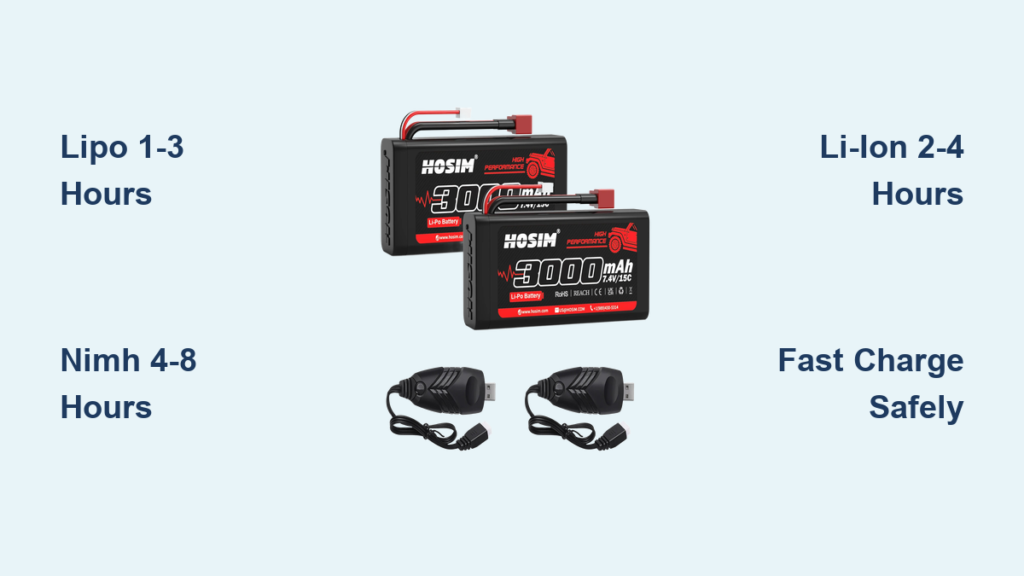
Nickel-Metal Hydride (NiMH) batteries remain popular in entry-level and mid-range RC cars due to their affordability and safety profile. These batteries typically require 4-8 hours for a complete standard charge depending on capacity and charger specifications. A standard 2000mAh NiMH pack with a 2A charger will need approximately 1.2 hours for a full charge (calculated as capacity divided by charge rate, plus 20-30% for inefficiency). However, many hobbyists use “trickle charging” overnight at lower amperage rates, extending total charging time to 8-12 hours. You’ll know your NiMH battery is fully charged when the charger indicator light changes from red to green or displays a steady green light. Never leave NiMH batteries on trickle charge for more than 24 hours, as this causes “overcharge damage” that significantly reduces battery lifespan.
LiPo Batteries: The Performance Powerhouse

Lithium Polymer (LiPo) batteries dominate the high-performance RC market for good reason—they deliver exceptional power-to-weight ratios and faster charging capabilities. Most RC LiPo batteries take just 1-3 hours for a standard charge at 1C rate (where C equals the battery’s capacity in amp-hours). For example, a 5000mAh (5.0Ah) LiPo charged at 5A will reach full capacity in approximately 1 hour under ideal conditions. Many modern LiPo batteries support 2C or even 5C fast charging, potentially reducing charge times to 30-60 minutes. Critical safety warning: Always charge LiPo batteries in a fireproof charging bag on a non-flammable surface, never leaving them unattended. Look for physical cues like slight warmth (not hot) and the charger’s balanced charging indicator to confirm proper charging completion. Never charge a swollen or damaged LiPo battery—it’s a serious fire hazard.
Li-ion Batteries: The Balanced Option
Lithium-ion (Li-ion) RC batteries offer a middle ground between NiMH and LiPo technologies, providing good energy density without the extreme sensitivity of LiPo packs. Standard charging times for RC Li-ion batteries range from 2-4 hours at 1C rate. A typical 3000mAh Li-ion pack will take about 2.5 hours to fully charge with a 1.5A charger. Unlike LiPo batteries, most RC Li-ion variants don’t support extremely high C-rates for charging, making them safer but slightly slower to recharge. When properly charged, Li-ion batteries should feel slightly warm to the touch—not hot—and your charger should display a solid green or blue indicator light. These batteries generally provide 500-800 charge cycles before significant capacity degradation occurs, making them a cost-effective long-term solution despite higher initial costs.
Factors That Dramatically Affect Your RC Charging Time
Battery Capacity vs. Charger Output: The Critical Relationship

Your RC car’s charging duration depends primarily on the mathematical relationship between battery capacity (measured in milliamp hours or mAh) and your charger’s output current (measured in amps). The basic formula is: Charge Time (hours) = Battery Capacity (Ah) / Charger Output (A) × 1.2 (accounting for inefficiency). For instance, a 4000mAh (4.0Ah) battery charged with a 2A charger requires approximately 2.4 hours for a full charge. Many RC enthusiasts make the costly mistake of using underpowered chargers that extend charging times unnecessarily—upgrading to a higher-amp charger compatible with your battery can cut charging time in half. Always verify your battery’s maximum safe charge rate (expressed as “C”) before selecting a charger; exceeding this rating risks battery damage or safety hazards.
Temperature’s Hidden Impact on Charging Efficiency
Ambient temperature significantly influences RC battery charging times, yet many hobbyists overlook this critical factor. Lithium-based batteries (LiPo and Li-ion) charge most efficiently between 68-77°F (20-25°C). Below 50°F (10°C), charging times increase by 20-30% as chemical reactions slow down, while temperatures above 86°F (30°C) trigger safety mechanisms that reduce charge rates to prevent thermal runaway. Never charge a battery immediately after use when it’s still warm from operation—allow it to cool to room temperature first. During winter months, charging times can double if you attempt to charge in an unheated garage. For optimal results, charge your RC batteries in a climate-controlled environment and monitor surface temperature; if the battery feels more than slightly warm, stop charging immediately.
Step-by-Step Guide to Optimizing Your RC Charging Routine
Selecting the Perfect Charger for Your Battery Type
Choosing the right charger eliminates unnecessary waiting and extends battery life. First, identify your battery chemistry (NiMH, LiPo, or Li-ion) as chargers are chemistry-specific. Next, calculate your ideal charge rate: for regular use, select a charger that delivers 1C output (e.g., 5A for a 5000mAh battery). Serious hobbyists benefit from multi-chemistry chargers with 50-100W output that support fast charging. When purchasing, prioritize chargers with these essential features:
- Automatic charge termination
- Individual cell balancing (for LiPo/Li-ion)
- Adjustable charge rates
- Safety cutoffs for temperature and time
- Digital display showing real-time metrics
Avoid cheap, unbranded chargers that lack proper safety features—these can damage batteries or create fire hazards. A quality charger pays for itself through extended battery life and reduced charging times.
Implementing Safe Fast-Charging Procedures
Fast charging can reduce your wait time by 50-75% when done correctly. For LiPo batteries rated for 2C charging, a 5000mAh pack can safely charge in just 30-40 minutes at 10A. Follow this precise procedure:
- Verify your battery’s maximum charge rate (stamped on the pack)
- Ensure the battery is at room temperature (68-77°F)
- Connect balance lead AND main power lead to charger
- Select correct battery type and capacity in charger menu
- Set charge rate to no more than 80% of maximum rated C
- Place battery in fireproof charging bag on non-flammable surface
- Monitor first 10 minutes for abnormal heat or swelling
- Never leave fast-charging batteries unattended
Fast charging generates more heat, so limit fast-charge cycles to 20-30% of total charges to maximize battery lifespan. After three fast charges, perform one standard rate charge to stabilize the battery chemistry.
Common Charging Mistakes That Waste Your Time

The “Set It and Forget It” Charging Trap
Many RC hobbyists plug in their batteries and walk away, only to discover hours later that charging never completed properly. This careless approach leads to three common problems:
- Incomplete charging: Faulty connections or charger errors stop charging prematurely
- Overcharging: Without automatic termination, batteries continue receiving current
- Missed safety issues: Swelling or overheating goes undetected
Instead, implement a charging checklist: verify connections, confirm charger settings, set a timer for expected completion, and perform visual checks at 50% completion. Modern smart chargers with Bluetooth connectivity send notifications to your phone when charging completes—well worth the small investment.
Using Incorrect Charging Modes for Your Battery
Selecting the wrong charging profile wastes time and damages batteries. Never use “LiPo” mode for NiMH batteries or vice versa. For multi-cell LiPo packs, always enable balance charging mode—skipping this step creates cell imbalances that reduce performance and require lengthy rebalancing procedures later. If your RC car came with a specific “storage charge” mode, use it for batteries stored longer than two weeks. Proper mode selection ensures optimal charging efficiency and prevents time-wasting corrective procedures down the road.
Extending Battery Life While Minimizing Charging Time
Implementing the 20-80 Charging Rule
For lithium-based RC batteries, charging only between 20-80% capacity dramatically extends lifespan with minimal impact on runtime. This practice reduces stress on battery cells, maintaining higher capacity through more charge cycles. To implement:
- Set your charger to stop at 80% for regular use
- Only perform full 100% charges before important events
- Recharge when capacity drops to 20% (most RC cars show low-voltage warnings)
- Use your charger’s “discharge” function to safely bring batteries to 50% for storage
This approach maintains 80-90% of your runtime while potentially doubling the number of useful charge cycles, saving you money on battery replacements.
Proper Storage Techniques That Prevent Charge Delays
How you store RC batteries between uses directly impacts next-session charging time. Batteries left fully charged or completely drained develop chemical imbalances that slow subsequent charging. Always store batteries at approximately 50% charge in a cool, dry place. For LiPo batteries, use your charger’s “storage” function which automatically adjusts voltage to the ideal storage level. Store batteries in fireproof containers away from metal objects that could cause short circuits. Before your next use, check storage voltage—batteries that have dropped below 3.7V per cell may require slow “recovery charging” that takes 2-3 times longer than normal.
Final Note: Understanding exactly how long it takes to charge your specific RC car battery type transforms frustrating downtime into productive preparation time. By matching your charger output to battery capacity, maintaining optimal temperatures, and avoiding common charging mistakes, you can consistently achieve the fastest safe charging times while extending your battery’s lifespan. Implement the 20-80 charging rule for lithium batteries and always prioritize balance charging for multi-cell packs—these simple practices save hours over a battery’s lifetime. When you’re ready for your next RC adventure, you’ll know precisely when your vehicle will be powered up and race-ready. For optimal performance, check your battery’s voltage before and after charging sessions, and consider investing in a second battery pack to eliminate charging wait times during extended play sessions.