Discovering your Traxxas RC car won’t power up can ruin your entire day at the track. Properly charging your Traxxas RC car isn’t just about plugging in a battery—it’s the foundation for consistent power delivery, extended run times, and protecting your investment from preventable damage. Many beginners make critical mistakes that shorten battery life or create dangerous situations, especially when handling lithium-based power systems.
This guide delivers exactly what you need to safely and effectively charge your Traxxas RC car, whether you’re using the stock NiMH battery that came with your Slash or the high-performance LiPo powering your XO-1. You’ll learn the exact steps to follow, how to interpret those confusing LED indicators, and crucial safety practices that prevent fires and equipment damage. By mastering these techniques, you’ll maximize your track time while extending your battery’s service life.
Traxxas Battery Types and Their Charging Requirements
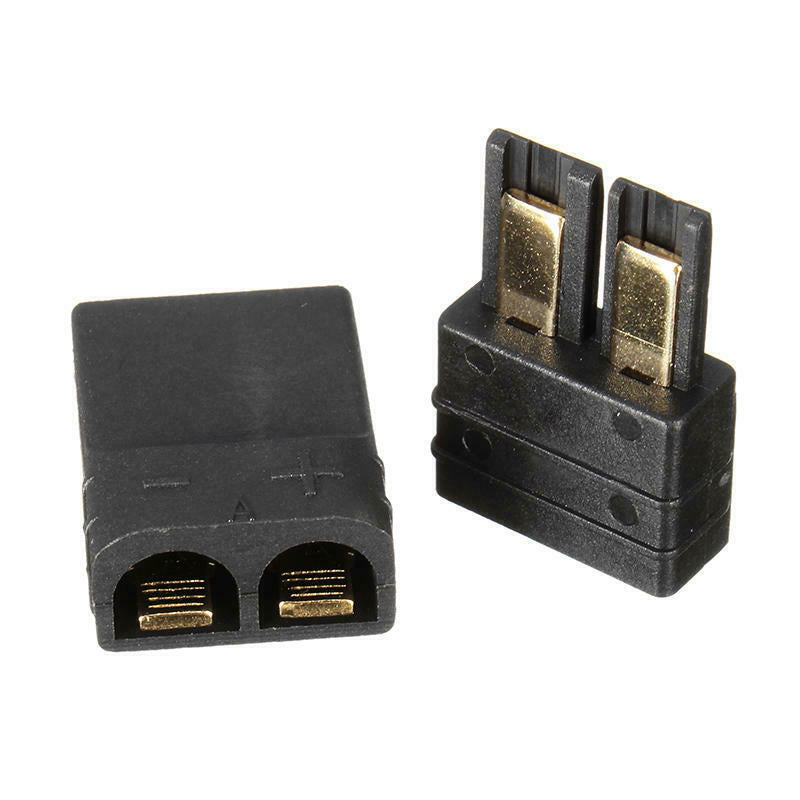
Choosing the right charging method starts with identifying your specific battery chemistry—getting this wrong can damage your equipment or create safety hazards.
Nickel-Metal Hydride (NiMH) batteries serve as the perfect entry point for new RC enthusiasts. These forgiving power sources tolerate minor charging errors and don’t require complex balance charging. When you plug your Traxxas NiMH battery into a compatible charger, it automatically detects the peak voltage point and terminates charging—no manual intervention needed. Look for the standard Tamiya-style connector on your battery pack to confirm you’re working with NiMH chemistry.
Lithium Polymer (LiPo) and Lithium-Ion (Li-ion) batteries deliver the high-performance power that makes Traxxas vehicles like the X-Maxx and TRX-4 so thrilling. However, these advanced batteries demand precise charging protocols. Unlike NiMH packs, LiPos require simultaneous connection through both the main power lead and balance lead to ensure each individual cell charges evenly. Never attempt to charge LiPo batteries with a standard NiMH charger—this mismatch can cause catastrophic failure.
Traxxas iD batteries solve compatibility issues with built-in intelligence that communicates directly with iD chargers. When you connect an iD battery, the charger automatically configures the correct charge rate, chemistry type, and safety parameters—eliminating dangerous configuration errors. This system is particularly valuable if you own multiple Traxxas models with different battery requirements.
Essential Charging Equipment Setup
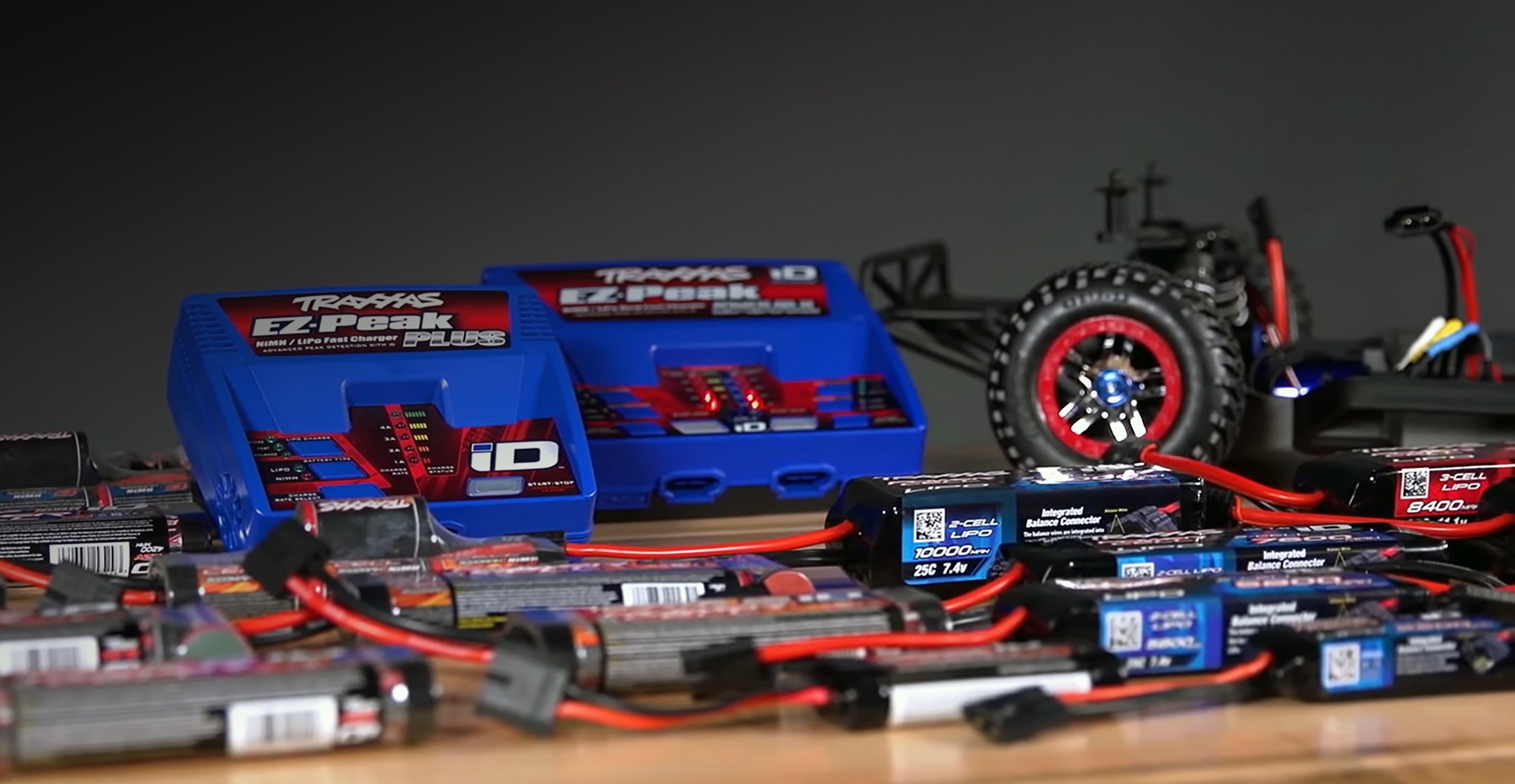
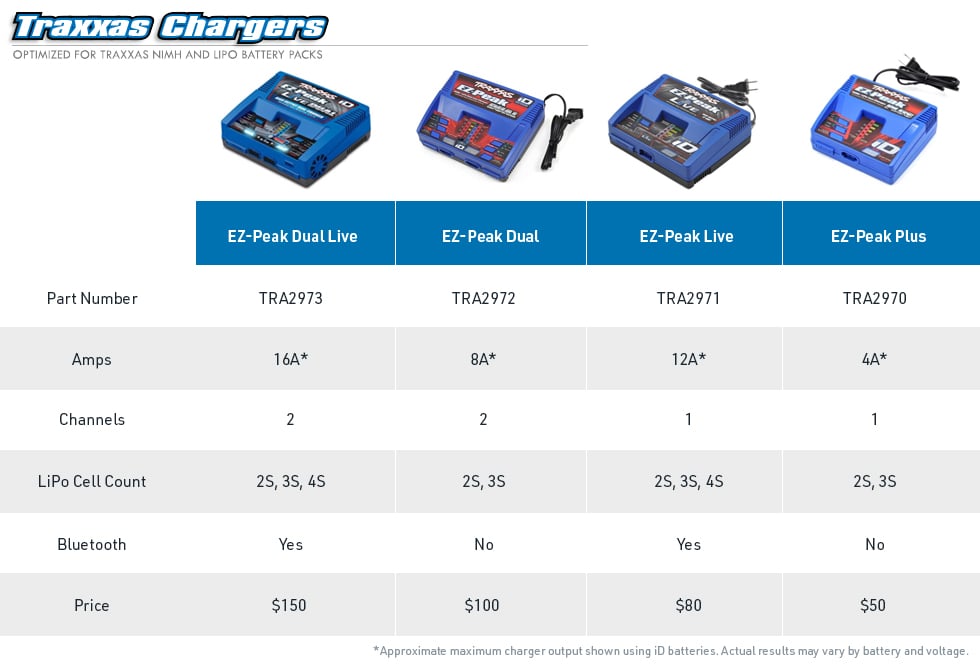
Your charger selection directly impacts both safety and performance—using improper equipment risks battery damage or even fire with lithium-based systems.
Traxxas AC chargers provide the simplest home charging solution with plug-and-play convenience. The EZ-Peak series automatically detects when NiMH batteries reach full capacity and terminates charging, preventing damaging overcharge cycles. These chargers feature clear LED indicators that show charging status at a glance—flashing green means active charging while solid green confirms completion.
Traxxas iD chargers like the iD Peak model represent the gold standard for hassle-free charging. When you connect an iD battery, the charger identifies the battery type, capacity, and optimal charge rate without manual input. The intuitive interface displays real-time information including voltage, charge current, and estimated completion time—taking the guesswork out of how to charge a Traxxas RC car properly.
Balance chargers are non-negotiable for LiPo and Li-ion batteries. These sophisticated units monitor each individual cell during charging to prevent dangerous imbalances. Always verify your balance charger supports the specific cell count of your Traxxas battery—using an incompatible balance charger can create serious safety hazards.
Step-by-Step Charging Procedure for All Battery Types
Follow this universal charging sequence regardless of your battery chemistry to maximize safety and performance.
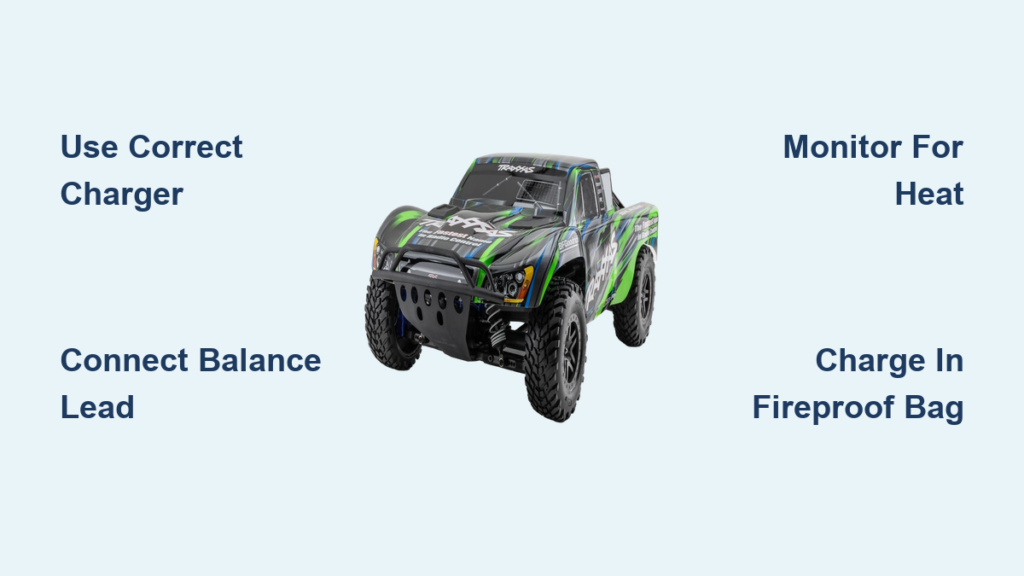
Prepare your charging area on a hard, non-flammable surface like concrete or tile—never on carpet or wood surfaces. Keep lithium batteries inside a fireproof charging bag during the process and maintain a safe distance from flammable materials. Ensure proper ventilation in your charging space and have a Class ABC fire extinguisher accessible.
Connect components in the correct sequence by plugging your charger into power first, then attaching the battery. For NiMH batteries, match the red and black connectors precisely to avoid reverse polarity damage. With LiPo batteries, connect both the main power lead AND the balance lead before starting the charge cycle—never skip the balance connection.
Initiate charging by pressing the start button on your charger. Watch for the initial status lights to confirm proper connection—most Traxxas chargers will display an error if connections are incorrect. For non-iD lithium batteries, verify you’ve selected the correct cell count and chemistry type before proceeding.
Monitor the entire charging cycle without leaving the area unattended, especially during the critical first 15 minutes. Check periodically for abnormal heat, swelling, or unusual odors—these indicate dangerous conditions requiring immediate shutdown. Lithium batteries should feel slightly warm but never hot to the touch during normal charging.
Decoding Charger Indicator Lights for Problem Prevention
Understanding your charger’s visual signals helps catch potential issues before they become serious problems.
Flashing green or amber lights indicate active charging in progress. A steady, rhythmic flash means normal operation while rapid or irregular flashing signals a problem—immediately check connections and battery condition. Some advanced chargers vary the flash pattern to communicate charge rate or battery health status.
Solid green or blue light confirms your battery has reached full capacity. While many Traxxas chargers automatically switch to trickle charge mode, it’s best practice to disconnect the battery within 30 minutes to prevent unnecessary stress on the cells. Leaving batteries connected for extended periods can gradually degrade performance over time.
Red lights or error codes demand immediate attention—disconnect the battery and investigate the cause before attempting another charge cycle. Common triggers include reversed polarity, damaged cells, or incompatible battery/charger combinations. Consult your charger manual for specific error code meanings before proceeding.
Critical Safety Practices for LiPo Battery Charging
Lithium polymer batteries require special handling procedures to prevent dangerous thermal runaway conditions.
Never charge damaged batteries showing any signs of physical compromise including swelling, punctures, or damaged connectors. Place suspect batteries in a fireproof container away from flammable materials and contact your local RC hobby shop for proper disposal guidance. A swollen LiPo battery represents an immediate fire hazard that should never be charged.
Always use fireproof charging containers specifically designed for RC applications when charging lithium batteries. These containers contain potential fires and prevent them from spreading to surrounding areas. Charge lithium batteries on non-flammable surfaces even when using charging bags for maximum safety.
Stay present during the entire charging cycle—never leave lithium batteries charging while sleeping or away from home. Thermal runaway can progress from normal operation to full combustion in under 90 seconds, making constant monitoring essential for safety.
Troubleshooting Common Charging Failures
Quickly diagnosing charging issues gets you back to driving with minimal downtime.
Battery won’t charge at all typically stems from reversed connections, depleted cells below detection threshold, or incompatible charger settings. First verify correct connector orientation—Traxxas uses red for positive and black for negative. Try charging a known-good battery to determine if the problem lies with your charger or the specific battery pack.
Charging stops prematurely often indicates battery imbalance or cell damage, particularly with lithium systems. Inspect for physical damage and check individual cell voltages if your charger provides balance port monitoring. For NiMH batteries, this issue may signal end-of-life deterioration requiring battery replacement.
Excessive heat during charging suggests incorrect charge rates or internal battery damage. Immediately stop charging and allow the battery to cool completely. Reduce your charge rate for subsequent attempts—most Traxxas batteries perform best at 1C charge rates (matching the battery capacity in amp-hours).
Maximizing Battery Service Life Through Proper Charging
Strategic charging habits significantly extend your battery’s useful lifespan and maintain peak performance.
Avoid complete discharges by recharging when your Traxxas vehicle shows reduced power rather than waiting until it stops completely. Lithium batteries particularly suffer when regularly discharged below 3.0 volts per cell, accelerating capacity loss with each deep cycle.
Store batteries at partial charge (40-50%) during periods of non-use longer than two weeks. Fully charged lithium batteries degrade faster in storage, while completely depleted packs can develop permanent damage from self-discharge. Check stored batteries monthly and adjust charge levels as needed.
Use appropriate charge rates based on your immediate needs—reserve fast charging for competition days and use standard 1C rates for regular maintenance charging. Slower charging generates less heat and causes less stress on battery cells, extending overall service life.
By implementing these precise charging techniques, you’ll maintain optimal power delivery for your Traxxas RC car while protecting your investment from preventable damage. The right charging practices deliver consistent performance run after run and significantly extend your battery’s service life—getting you more track time with fewer replacements. Always consult your specific vehicle and battery manuals for model-specific guidance, as charging requirements vary across Traxxas’ extensive product line.