You’re ready for an afternoon of RC car racing when you discover your charger is missing or broken. That sinking feeling is familiar to every RC enthusiast—your LiPo or NiMH battery is dead, and you have no way to charge it. Without proper charging, your RC adventures come to an abrupt halt. This guide reveals verified emergency methods to safely charge your RC car battery when you don’t have your dedicated charger, using common household items while avoiding dangerous shortcuts that could damage your battery or cause fire hazards.
Why Standard RC Chargers Are Essential (And When You Might Need Alternatives)
RC car batteries require precise voltage and current control that standard wall chargers don’t provide. Most RC vehicles use either NiMH (Nickel-Metal Hydride) or LiPo (Lithium Polymer) batteries, each with specific charging requirements. NiMH batteries typically need 1.2V per cell while LiPo requires 4.2V per cell with strict current limitations. Using improper charging methods risks overheating, reduced battery life, or in extreme cases, fire—especially with LiPo batteries that contain flammable electrolytes.
Critical Differences Between Battery Types
NiMH Batteries (6-12V Common):
– Tolerate slight overcharging better than LiPo
– Require current-limited charging (typically 1-5A)
– Show voltage drop when fully charged (delta-V detection)
– Less prone to fire but can leak or bulge if severely mishandled
LiPo Batteries (7.4V-11.1V Common):
– Must never exceed 4.2V per cell
– Require constant current/constant voltage (CC/CV) charging
– No tolerance for overcharging—can swell or ignite within minutes
– Need balancing between cells during charging
When Emergency Charging Might Be Necessary
- Traveling to a competition with a dead battery and no charger
- Charger failure during multi-day racing events
- Remote location with limited resources
- Temporary solution while awaiting replacement charger
Safe Alternative Charging Methods for NiMH Batteries
Using a Bench Power Supply with Current Limiting

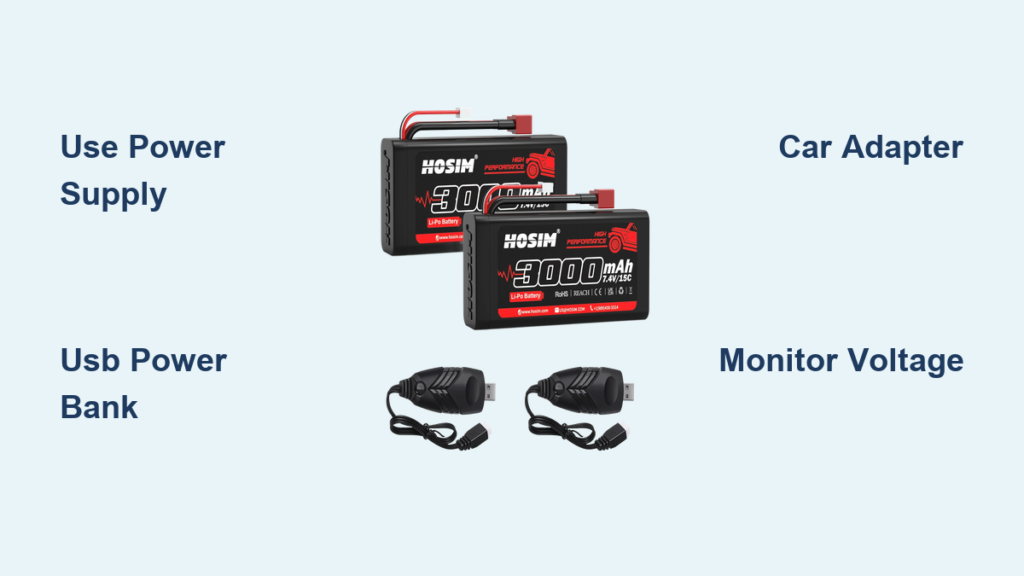
When you have access to a laboratory power supply, you can safely charge NiMH batteries by manually controlling voltage and current. Set the power supply to 1.45V per cell (for example, 8.7V for a 6-cell pack) and limit current to 1-2A for standard packs. Monitor voltage closely—when it peaks and begins to drop slightly (typically 10-20mV per cell), the battery is fully charged. This method requires constant supervision and takes approximately 1-2 hours depending on capacity.
Critical Safety Checks During Charging
- Verify battery temperature every 15 minutes (should remain cool to touch)
- Watch for unusual swelling or odor
- Confirm voltage doesn’t exceed 1.55V per cell
- Never leave unattended for more than 10-minute intervals
USB Power Bank Method for Small Capacity NiMH Packs
For smaller 2S or 3S NiMH packs (2.4V-3.6V), a high-current USB power bank can serve as an emergency solution. You’ll need:
– USB power bank with at least 2.4A output
– USB to DC cable with appropriate connector
– Multimeter for monitoring
Connect the USB cable to your battery terminals (observing polarity), set the power bank to constant output mode if available, and monitor voltage continuously. Charge at no more than 0.5C rate (for a 2000mAh pack, maximum 1A). Stop charging when voltage reaches 1.45V per cell. This method works best for small-scale RC cars and should not exceed 30 minutes of charging time.
Extremely Limited Options for LiPo Batteries
Why LiPo Batteries Require Extreme Caution
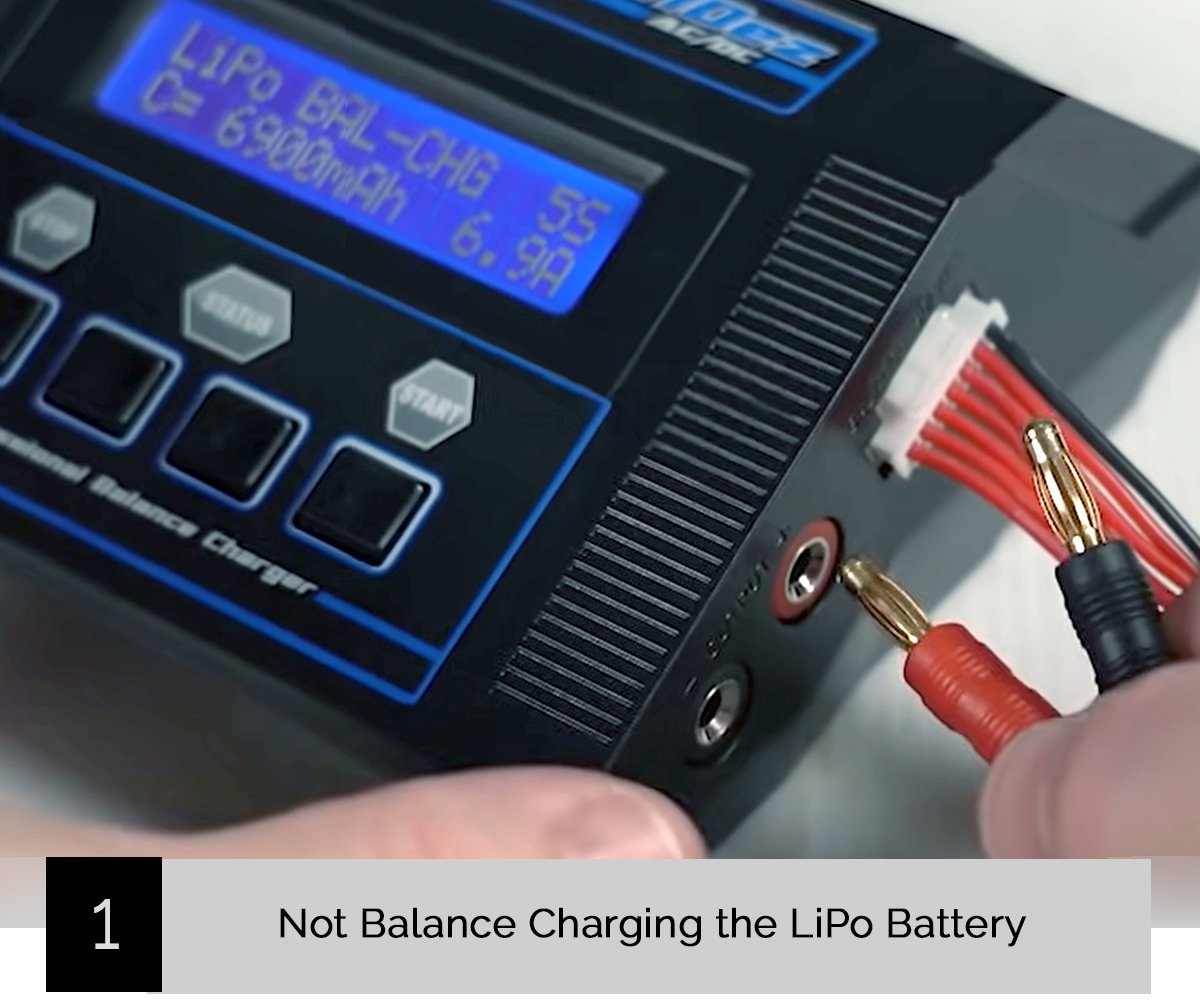
Attempting to charge LiPo batteries without a proper balance charger carries significant risks. Unlike NiMH, LiPo batteries have no safe overcharge tolerance—exceeding 4.2V per cell even slightly can trigger thermal runaway. Without cell balancing, individual cells can become dangerously overcharged while others remain undercharged.
Emergency 12V Car Adapter Method (For Single-Cell Only)
For a single-cell (3.7V) LiPo in an absolute emergency, a car battery with a 12V to 5V USB adapter can work with extreme precautions:
1. Use only with 1S LiPo batteries (3.7V nominal)
2. Connect through a 5V USB port, never directly to 12V
3. Insert a 1A fuse between the USB adapter and battery
4. Monitor voltage constantly with a multimeter
5. Stop immediately when voltage reaches 4.15V
This method should never be used for 2S or higher LiPo packs. Charge time will be approximately 2-3 hours for a depleted battery, but you must check voltage every 5 minutes after the first 30 minutes.
Universal Safety Protocols for Emergency Charging
Fire Prevention Measures
- Always charge on non-flammable surface (concrete, stone, metal)
- Keep fire extinguisher (Class D recommended) within immediate reach
- Never charge on carpet, wood, or near flammable materials
- Place battery in LiPo safety bag even during emergency charging
- Have water source available (though ineffective for LiPo fires)
Warning Signs That Require Immediate Termination
- Battery temperature exceeding 120°F (49°C)
- Visible swelling or puffing of the battery pack
- Unusual odor (fishy or chemical smell)
- Voltage rising faster than expected
- Any sparking or smoke
What Absolutely NOT to Do When Charging Without a Charger
Dangerous Myths That Could Destroy Your Battery
❌ Using a Laptop Charger Directly on Battery Terminals
Laptop chargers output unregulated voltage that can easily exceed safe limits for RC batteries. A typical 19V laptop charger connected directly to a 7.4V LiPo will cause immediate catastrophic failure.
❌ Connecting to Car Battery Without Regulation
Car electrical systems operate at 13.8V when running—far too high for any RC battery. Direct connection will cause rapid overheating and likely fire.
❌ Using Phone Chargers for Multi-Cell Packs
Standard 5V USB chargers cannot properly charge 2S+ LiPo packs (7.4V+). Attempting this prevents full charging and creates dangerous cell imbalances.
❌ Charging Overnight or Unattended
Emergency charging requires constant monitoring. Never leave alternative charging methods operating while sleeping or away from home.
When to Abandon Emergency Charging Attempts
Certain situations require you to stop immediately and seek proper equipment:
– Any visible damage to the battery pack (dents, punctures, swelling)
– Previous incidents of over-discharge (below 3.0V per LiPo cell)
– Lack of proper voltage monitoring tools
– Uncertainty about battery chemistry or specifications
– Absence of fire safety equipment
Temporary Solutions While Waiting for Proper Charger
Battery Swapping Strategies
- Join RC clubs where members often carry spare chargers
- Visit local hobby shops—they frequently assist with emergency charging
- Check if competition venues have charging stations
- Carry a second battery pack when traveling
Preventing Future Emergencies
- Always pack a backup charger for events
- Include a universal hobby charger that accepts multiple input sources
- Carry a power bank specifically designed for RC batteries
- Store batteries at 50% charge when not in use for extended periods
Essential Tools for Every RC Enthusiast’s Emergency Kit

Every serious RC hobbyist should maintain a portable emergency charging kit containing:
– Multimeter for voltage monitoring
– 1A and 2A fuses
– Alligator clip test leads
– LiPo safety bag
– Small fire extinguisher
– USB to DC adapter cables
– Current-limited bench power supply (compact models available)
Final Safety Reminder
While these emergency methods can get you through a difficult situation, they should never replace your proper RC charger for regular use. Dedicated RC chargers provide critical safety features including automatic cutoff, cell balancing, and temperature monitoring that improvised methods cannot replicate. After any emergency charging session, thoroughly inspect your battery before using it in your RC car, and consider replacing it if you noticed any abnormalities during charging.
The best approach is prevention—invest in a quality multi-chemistry charger and always carry backup charging options when traveling to races or remote locations. Your safety and the longevity of your RC investment depend on respecting the precise electrical requirements of modern battery technology.