
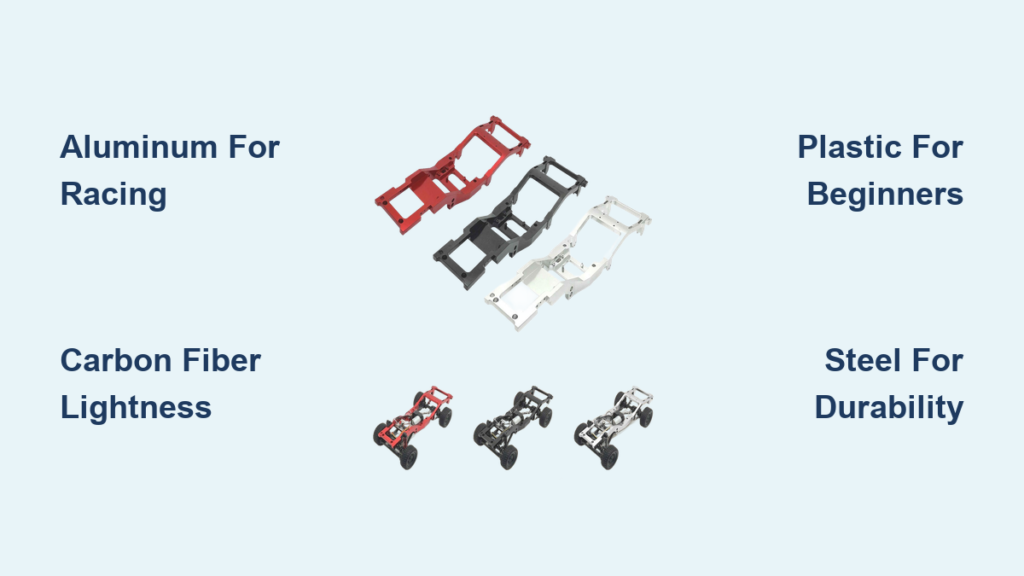
Your RC car’s performance starts with one critical component you might overlook—the chassis. As the structural backbone of your vehicle, the rc car chassis material directly determines how well your machine handles jumps, corners, and crashes. Whether you’re dominating the track or exploring rugged trails, selecting the right chassis foundation impacts speed, durability, and overall driving satisfaction. Many beginners focus solely on motors and batteries while neglecting this crucial element, only to wonder why their RC car doesn’t perform as expected.
The wrong rc car chassis material can transform a promising build into a frustrating experience. Too flexible, and your suspension geometry goes haywire mid-corner; too rigid, and your tires lose traction on uneven surfaces. This guide cuts through the confusion by comparing the most common chassis materials used today, highlighting exactly how each affects real-world performance. You’ll discover which material delivers the perfect balance of strength, weight, and value for your specific driving style.
How RC Car Chassis Material Impacts Your Lap Times

Your chassis isn’t just a platform—it’s an active performance component that affects every aspect of driving dynamics. The rc car chassis material determines how energy transfers from your motor to the ground, influencing acceleration responsiveness and cornering precision. Aluminum chassis provide immediate power delivery that competitive racers love, while carbon fiber offers predictable flex that maintains tire contact during high-speed maneuvers.
Consider these specific performance impacts based on your rc car chassis material choice:
- Weight distribution: Lighter materials like carbon fiber allow strategic placement of mass for optimal handling
- Vibration damping: Plastic composites absorb more shock than rigid metals, protecting sensitive electronics
- Heat dissipation: Aluminum chassis pull heat away from motors 3x faster than plastic alternatives
- Torsional rigidity: Carbon fiber maintains precise suspension geometry during aggressive cornering
When selecting your rc car chassis material, think beyond basic strength. A chassis that’s too stiff for your driving surface creates a “skatey” feel as tires lose contact with bumps, while excessive flex makes the car feel vague and unresponsive. Top racers actually choose different chassis materials based on track conditions—stiffer for smooth asphalt, slightly more flexible for outdoor dirt courses.
Aluminum Chassis Plates: The Track-Ready Standard

Aluminum dominates competitive RC racing for good reason—it delivers the best balance of performance characteristics for most serious hobbyists. When building or upgrading your RC vehicle, choosing the right aluminum alloy and thickness makes all the difference in your rc car chassis material selection. The 6061-T6 aluminum alloy remains the gold standard, offering exceptional machinability while maintaining strength after anodizing.
Here’s what you need to know about aluminum chassis plates:
- Thickness options: 2mm for lightweight racing, 2.5mm for all-around use, 3mm+ for bashers needing durability
- Heat management: Aluminum chassis pull heat away from motors significantly better than composites
- Tuning flexibility: Swap specific plates (front vs rear) to adjust handling balance
- Cost efficiency: Typically 30-50% less expensive than equivalent carbon fiber components
While working with aluminum rc car chassis material, watch for these common issues:
– Bending under impact: Unlike composites, aluminum tends to deform rather than crack
– Electrical conductivity: Requires careful insulation to prevent shorts between components
– Thread stripping: Use thread-locking compounds on all mounting hardware
Most competitive racers start with aluminum chassis because they offer tremendous value and tunability. You can experiment with different thicknesses and configurations without breaking the bank, then upgrade to carbon fiber once you’ve mastered setup fundamentals.
Carbon Fiber Chassis: The Performance Edge
For racers chasing every possible advantage, carbon fiber represents the pinnacle of rc car chassis material technology. The exceptional stiffness-to-weight ratio means a properly designed carbon fiber chassis delivers noticeably sharper handling than aluminum equivalents. When every millisecond counts on the track, the rigidity of carbon fiber translates directly to faster lap times through improved power transfer and precise suspension control.
Key advantages of carbon fiber chassis include:
- Weight savings: Typically 30-40% lighter than equivalent aluminum chassis
- Consistent performance: Doesn’t deform over time like aluminum under repeated stress
- Engineered flex: Manufacturers can tune flex characteristics through fiber orientation
- Long-term value: Maintains properties through seasons of competitive use
Despite the premium price tag (often 2-3x aluminum), serious competitors consider carbon fiber chassis worth the investment. The material’s predictable failure mode—catastrophic shattering rather than gradual bending—actually provides safety advantages on the track, as there’s no risk of a weakened chassis failing unexpectedly mid-race.
When maintaining your carbon fiber rc car chassis material, remember these critical points:
– Inspect thoroughly after any hard impact using the “coin tap test” for internal damage
– Always use nylon washers between carbon fiber and metal components to prevent galvanic corrosion
– Check for electrical shorts regularly since carbon fiber conducts electricity
Plastic and Composite Chassis Solutions for Beginners

Most entry-level RC cars feature plastic or composite chassis for excellent reasons—they’re affordable, durable, and perfect for learning. The rc car chassis material in beginner models typically uses high-impact polymers like nylon or polycarbonate that can withstand countless crashes without permanent damage. This forgiveness makes plastic chassis ideal for newcomers developing their driving skills.
Modern composite chassis offer surprising performance benefits:
– Impact absorption: Plastic chassis flex and rebound rather than crack or bend permanently
– Electrical insulation: Eliminates short circuit risks common with conductive metals
– Cost efficiency: Replacement parts cost a fraction of aluminum or carbon fiber equivalents
– Lightweight construction: Often lighter than equivalent aluminum components
When selecting your first RC vehicle, prioritize plastic chassis if you:
– Are still developing throttle and steering control
– Plan to drive in tight backyard environments
– Want maximum uptime between battery changes
– Prefer lower initial investment with room to upgrade later
The primary limitation of plastic rc car chassis material appears when pushing performance limits. Under sustained high heat from powerful brushless systems, some plastics can warp, altering suspension geometry. Also, repeated stress at mounting points may cause cracking that requires reinforcement with metal inserts.
Steel and Specialty Metals: Niche Applications
While less common, steel chassis components serve specific purposes in the RC world. The rc car chassis material choice of steel makes sense only in particular scenarios where extreme durability outweighs weight concerns. Most serious hobbyists use steel selectively rather than for entire chassis construction.
Strategic steel applications include:
– Crawler bumpers and skid plates: Where maximum impact resistance matters most
– Heavy-duty shock towers: For rock crawlers navigating extreme terrain
– Axle housings: Where strength trumps weight considerations
– Hardware reinforcement: Steel inserts in plastic chassis mounting points
Titanium represents another niche rc car chassis material option for weight-conscious builders who need exceptional strength. Though prohibitively expensive for most hobbyists, titanium’s strength-to-weight ratio outperforms aluminum while providing better corrosion resistance. You’ll typically find titanium only in high-end racing applications where every gram counts.
Choosing Your Ideal RC Car Chassis Material
Selecting the right rc car chassis material requires honest assessment of your actual driving habits rather than aspirational performance goals. Consider these decision factors:
For racers: Aluminum provides the best entry point, with carbon fiber becoming worthwhile as you advance. Most competitive classes allow either material, so start with aluminum to master setup fundamentals before upgrading.
For bashers: Hybrid approaches work best—aluminum main chassis with plastic bumpers and guards. This combination delivers responsive handling while protecting against crash damage.
For crawlers: Prioritize durability with steel-reinforced aluminum or composite chassis. The added weight improves low-speed crawling control and stability on steep inclines.
For beginners: Plastic or composite chassis offer the most forgiving experience while you develop driving skills. The lower cost of replacement parts keeps frustration levels down during the learning curve.
Before making your final rc car chassis material decision, ask yourself:
– How often will I actually race competitively?
– What’s my realistic crash frequency?
– Am I willing to inspect and maintain a premium chassis?
– Will I actually notice the performance difference in my typical driving?
Maintaining Your Chassis Investment
Proper maintenance extends the life of any rc car chassis material. Aluminum requires regular inspection of mounting points for hairline cracks and elongated holes. Carbon fiber needs thorough impact checks using visual inspection and the coin tap test for internal damage. Plastic chassis benefit from UV protection to prevent sun degradation during storage.
Regardless of your rc car chassis material choice, establish these maintenance habits:
– Clean thoroughly after every outing to remove dirt and debris
– Check all mounting hardware for tightness before each run
– Inspect for stress cracks at high-load points (motor mounts, suspension links)
– Store properly away from direct sunlight and extreme temperatures
When replacing your chassis, consider upgrading specific components rather than the entire platform. Many racers start with aluminum and later replace only the most critical plates with carbon fiber for targeted performance gains.
Conclusion: Build Confidence Through Smart Material Selection
Your rc car chassis material choice fundamentally shapes your entire RC experience. Aluminum delivers the best all-around performance for most enthusiasts, offering tremendous value and tunability. Carbon fiber provides measurable performance advantages for serious competitors willing to invest in premium components. Plastic chassis serve beginners exceptionally well by forgiving early mistakes while delivering satisfying performance.
Rather than chasing the “best” material on paper, select the rc car chassis material that matches your actual driving style and commitment level. Most successful hobbyists progress through materials as their skills develop—starting with plastic, moving to aluminum, then selectively incorporating carbon fiber components. This approach builds confidence through achievable performance gains while maximizing your enjoyment of the hobby. Remember, the perfect chassis isn’t the most expensive one—it’s the one that keeps you smiling lap after lap.